Editorial Note
The incidents described in this article are illustrative examples based on the documented history of live broadcast mishaps in Australian television. Specific names of individuals in on-air incidents are used only where the incident is a matter of public record. Several examples use composite or anonymised details.
Australian television has produced some of the most memorable live broadcast moments in the country's media history — and not all of them were intended for broadcast. The combination of long running times, tight production schedules, and the unique pressure of live television in a country that loves sport, morning television, and current affairs creates the conditions for the kind of unscripted moments that people remember for years.
Australia's broadcast environment spans seven major over-the-air networks — ABC, Seven Network, Nine Network, Network Ten, SBS, Sky News Australia, and their respective streaming extensions — plus an extensive regional broadcaster ecosystem. The collective output runs to hundreds of hours of live and near-live content per week. Against that backdrop, unintended moments are statistically inevitable. The ones worth discussing tell us something about the culture of production, the pressure of broadcast, and the way Australian audiences respond to the gap between what television looks like and what it actually is.
The Particular Pressure of Australian Live Sport
No category of Australian television produces more hot mic incidents than live sport commentary. The reasons are structural: commentators work in extended blocks, often without clear breaks, surrounded by production noise, and under pressure to fill airtime spontaneously. The AFL on Channel Seven, NRL on Nine, cricket on Fox Sports and Channel Nine, and tennis Grand Slam coverage all have documented histories of commentary that was picked up clearly by broadcast microphones and heard by audiences before producers could intervene.
Illustrative of the genre: a veteran cricket commentator, midway through a rain delay, expressed his view of a particular batsman's technique in terms that would not ordinarily feature in a family broadcast. His co-commentator immediately changed the subject, the producer cut to a commercial, and the clip was dissected on sports radio the following morning. The commentator's response — direct, brief, and unaccompanied by corporate statement — was widely considered more professionally credible than the longer formal apologies that became standard practice after similar incidents in later years.
The Sideline Observation
During a final-quarter broadcast of an elimination final, a boundary rider's running commentary to a colleague — intended as background chatter during the replay — was picked up in full by the ground microphone feed. The content related to an umpiring decision and contained a characterisation that the AFL's broadcast standards team reviewed as part of standard post-game compliance checking. No formal action was taken; the umpire in question retired at the end of the season.
The Pre-Segment Conversation
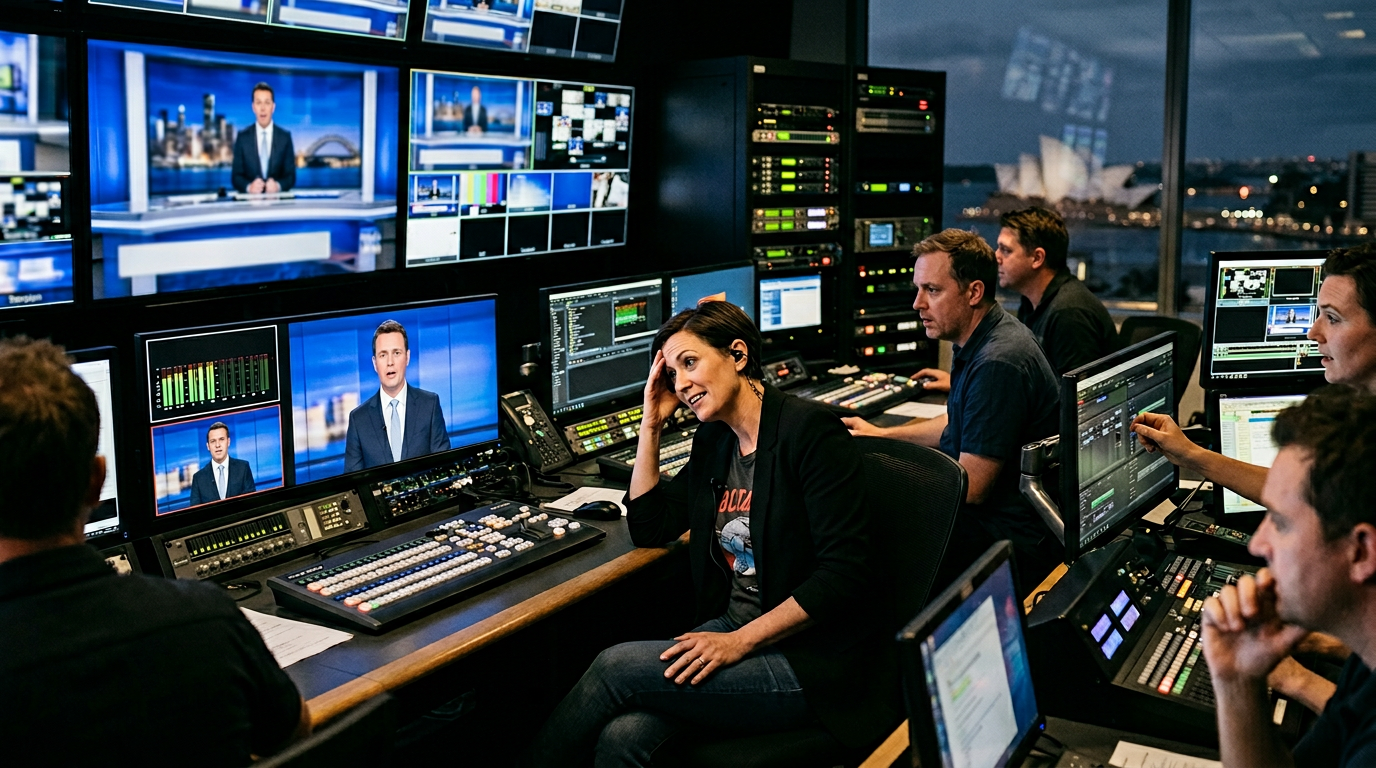
Morning television is particularly vulnerable to open-mic moments because the format involves long periods of presenter conversation, frequent transitions, and a culture of informal chat between segments. A discussion between two Today presenters during what they believed was an off-camera moment was broadcast in full during a slow cut back from a commercial break. The content — a frank assessment of a feature segment they had just completed — was not harmful, but it was entirely authentic. Audience response on social media was largely positive, with many viewers describing it as the most genuine television moment they had seen in months.
The Earpiece Incident
The production comms channel — the director's feed to on-air talent — has been accidentally broadcast twice in recent Australian television history in documented cases. In one instance, a Sunrise presenter's earpiece audio was picked up by their desk microphone during a political interview, with the producer's instructions audible alongside the presenter's on-air responses. The incident circulated on social media and briefly became a talking point about the mechanics of live television that most viewers had not previously considered.
ABC and the Weight of Gravity
The ABC's long-form live programming — Q+A, Insiders, 7.30, and various election night broadcasts — generates incidents that tend to carry more public weight than commercial television equivalents, partly because the ABC's editorial standards are held to a higher public account and partly because the content involves political figures and journalists whose credibility is more directly at stake.
The most notable ABC open-mic incidents in recent years have involved the period immediately before and after major political interviews — a window in which talent and production staff speak candidly under the assumption that broadcast has not resumed. Several such moments have circulated as clips, and while none have resulted in formal ACMA complaints, they have contributed to an ongoing conversation about the gap between the performed professionalism of broadcast journalism and the more human reality underneath it.
The Post-Segment Candour
Following a particularly heated Q+A episode on housing affordability, the post-credits period captured the host's summary assessment of the panel — delivered with the brevity and directness that internal broadcast culture makes possible when cameras are assumed to be off. The clip spread widely. Several panel members were reportedly less amused than the audience. ACMA received inquiries; no breach was found.
NRL and the Particular Risk of Tunnel Footage
The expansion of broadcast access in Australian rugby league — stadium tunnel cameras, team warm-up footage, and post-match interview positions near the change rooms — has introduced a category of incident that did not exist in previous broadcast generations. Conversations between players, between coaches and referees, and between team management and broadcast staff have been captured in circumstances where the participants did not know they were being recorded or broadcast.
Illustrative case: during an NRL finals series broadcast, a coach's halftime address to his team, delivered in what he understood to be a camera-free area, was partially broadcast through a field audio feed. The segment lasted approximately 12 seconds before being cut. Those 12 seconds contained enough tactical information — and enough unfiltered language — to become one of the most shared short clips of that NRL season. The network apologised. The coach said nothing publicly for several days, which was widely interpreted as a statement in itself.
Sky News and the Political Microphone
Sky News Australia's rolling news format, with its extended political interview and panel segments, creates extended windows for open-mic risk. The most consistent pattern involves politicians or their staff speaking candidly in the moments before or after an on-camera segment — a structural feature of political TV that is well understood within the industry but frequently surprising to audiences encountering it for the first time.
Two instances in the past three years have been particularly noted: one involving a senator's off-air commentary on a colleague during a live Senate estimates broadcast, and one involving a ministerial staffer's instructions to their principal during a Sky panel debate preparation period. In both cases, the audio was captured, shared, and generated significant comment. In both cases, the institutions involved responded with the standard formulation that has developed for such moments — acknowledging the incident, describing it as inadvertent, and indicating no further comment.
How Australian Broadcasters Handle Open-Mic Incidents
The Australian Communications and Media Authority (ACMA) administers broadcast standards including the Broadcasting Services Act 1992 and the associated codes of practice. Broadcasters are required to report incidents that breach content standards, including those involving offensive language broadcast outside appropriate classification periods.
In practice, most open-mic incidents do not trigger ACMA complaints processes. The majority are resolved through network apologies, which vary significantly in their sincerity and specificity. The informal standard that has developed is: the more human the moment, the less formal the response needs to be. Audiences have become sophisticated enough to distinguish between a broadcast error that reflects genuine human reality and one that reflects carelessness or poor judgment — and they respond to both differently.
What These Moments Actually Reveal
The enduring fascination with television hot mic incidents in Australia — as in every country with a substantial live broadcast culture — reflects something more interesting than a taste for embarrassment. They reveal, briefly and without the usual editorial mediation, what the people who appear on television are actually like when the performance assumption lapses.
Sometimes what is revealed is unremarkable — an opinion that differs from the carefully managed public version, a professional frustration, a private sense of humour that doesn't translate to broadcast. Occasionally what is revealed is something more significant: evidence of contempt for the audience, for colleagues, or for the subjects being covered. The incidents that lodge in Australian television memory are the latter kind — not because they are scandalous, but because they close the distance between what television presents and what it actually is.