A Send-Off That Reflected a Life of Giving
Thanh Nguyen had operated a fresh produce stall at the Cabramatta Farmers' Market in Sydney's south-west for more than two decades. He was not famous outside his neighbourhood. He did not hold public office or run a large company. What he had built, quietly and over many years, was something harder to quantify: a reputation for generosity that reached across the Vietnamese-Australian community in Fairfield and into the broader network of vendors, customers, and neighbours who had encountered him over the course of an ordinary working life.
He extended credit to struggling families during hard months. He helped new stall holders get set up at the market when they arrived with little knowledge of how things worked locally. When people in his building or on his street were going through difficult times, he arrived with groceries and left without making a point of it. Those who knew him describe these habits not as acts of occasional charity but as a consistent, almost reflexive response to need — the way some people think of generosity as something done once in a while, and others simply live it.
When he died, his children decided the tribute needed to be on the same scale as the way he had lived. Quiet and private would not have reflected him accurately. Something large, impractical, and impossible to ignore — that was more his register.
What Happened Outside the Funeral Home
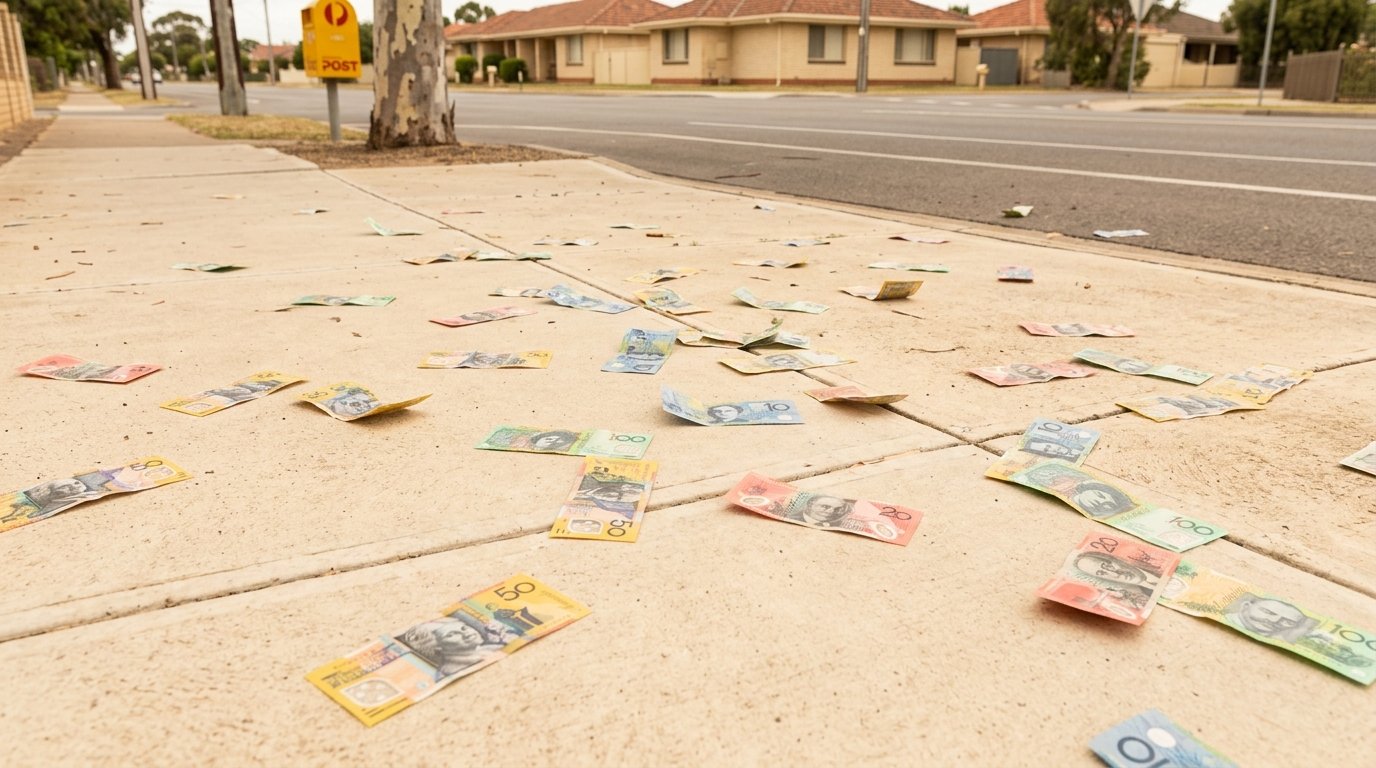
On a Saturday morning in late autumn, family and friends gathered outside the funeral home in Fairfield for the service. As the crowd assembled, a helicopter appeared low overhead — lower and slower than most people expected. First came wildflowers: wattle and native grevilleas drifting down across the crowd in loose clusters, catching the morning light as they fell. Then came cash — bills scattered from the aircraft that caught people completely off guard.
The moment lasted perhaps forty-five seconds from when the helicopter was first clearly audible to when it banked away. In that time, it generated footage that was captured from multiple angles by attendees with phones and shared to social media within the hour. By early afternoon the clips had spread far beyond Fairfield, attracting hundreds of thousands of views and generating commentary from across Greater Sydney and beyond.
"He always believed that generosity should be visible and that money was most useful when it reached people who needed it. The helicopter was entirely his kind of gesture — large, impractical, and impossible to ignore."
— Thanh Nguyen's family, in a statement to local media
The family confirmed afterward that the tribute had been planned deliberately and at some cost. Their father had spoken over the years about how visible generosity normalised giving — that people were more likely to be generous themselves when they saw it done publicly and without embarrassment. The helicopter, in that sense, was not showmanship. It was philosophy.
How the Community Responded
The reaction in Cabramatta and the surrounding Vietnamese-Australian community was immediate and overwhelmingly warm. The market stalls stayed closed for the morning. Several of Thanh's long-standing customers travelled from other suburbs to attend the service or stand outside as the helicopter passed. A community Facebook group dedicated to the Fairfield area accumulated thousands of comments, many from people who had never met him but recognised in the tribute a kind of story that does not travel as often as it should: someone who used what they had to make their immediate world better, for decades, without calling attention to it.
Several journalists and cultural commentators noted that the moment resonated in part because it happened in a part of Sydney that rarely features in the kind of stories Australians share widely. Cabramatta and Fairfield are among the most culturally diverse postcodes in the country, home to communities whose contributions to Australian life are consistently underreported. The helicopter over a Fairfield funeral home became, briefly, a different kind of image of Sydney: not the Harbour Bridge or Bondi Beach but a community moment, specific and human.
What Happens to the Money
A common question in the days following was practical: what happens to cash scattered in a public space in Australia? Under Australian law, found property has no universal statutory framework — treatment varies by state and circumstance. For a clearly deliberate distribution of this kind at a private event, no legal obligation to report found money typically applies. Several attendees confirmed they used the bills they caught to make donations in Thanh's name, which the family described as the best possible outcome.
The cost of the tribute — the helicopter charter, the flowers, the planning — was covered entirely by the family and was, by their account, a considered decision rather than a spontaneous one. They had discussed it for weeks before the service. Their father had not left specific instructions, but they felt confident they understood what he would have wanted: something you could not miss, and something that ended with people having a little more than they had before.
In that sense, the tribute was consistent with the life it was meant to honour. Thanh Nguyen spent decades making sure that the people around him had what they needed. On the day his family said goodbye to him, they arranged for that to happen one more time.