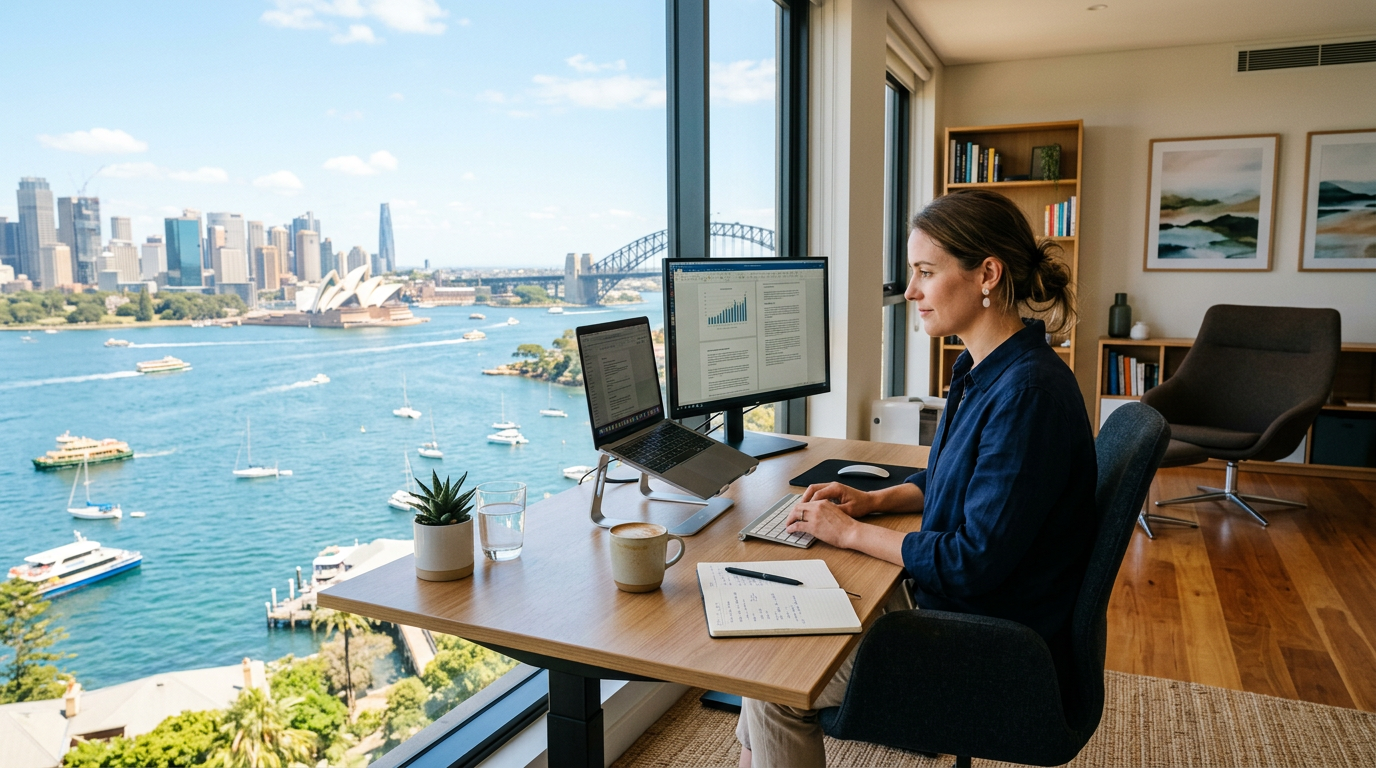
Three years after hybrid work became standard practice across corporate Australia, the commercial property market has reached a reckoning point. Office vacancy rates in Sydney and Melbourne's CBDs have stabilised at levels that would have been considered alarming in 2019, and a growing body of evidence suggests that the shift in how Australians use office space is structural rather than cyclical. The knock-on effects are reshaping everything from lease structures to the design of suburban town centres to the way Australian businesses think about talent recruitment.
The national office vacancy rate reached 14.2 percent at the end of Q1 2026, according to Property Council of Australia market data (industry estimates; figures subject to revision) — the highest since the early 1990s recession. Prime-grade space has fared considerably better than secondary-grade; the divergence between well-located, well-amenitised premium office buildings and older stock has widened to the point where some analysts are describing two entirely different markets operating under the same vacancy headline.
Sydney: The Premium Flight
Sydney's CBD vacancy rate sits at around 12.8 percent, but this figure conceals a significant split between A-grade and B/C-grade stock. Premium buildings with end-of-trip facilities, high NABERS energy ratings, and genuine amenity — the type of space that makes commuting from the suburbs feel worthwhile — are running at closer to 7 percent vacancy and attracting the strongest rents in the city's recorded history. Older buildings without these characteristics are experiencing effective abandonment by major tenants renewing leases, with conversion to residential, hotel, or student accommodation emerging as the most discussed solution for the oversupply problem.
The shift in tenant behaviour has been most visible in the growth of shorter lease terms. In 2019, the average Sydney CBD office lease ran for approximately 5.2 years. By 2026, that average has contracted to 3.4 years as tenants seek flexibility to adjust their footprint as hybrid work patterns evolve. Landlords have responded with greater incentives — fit-out contributions, rent-free periods — but at the cost of effective yield compression across the sector.
Melbourne: Suburban Centres Gain Ground
Melbourne's office market has experienced a more pronounced shift than Sydney's, partly because the city's CBD recovery from COVID-19 lockdowns was slower and the psychological association between Melbourne's CBD and the pandemic period ran deeper. Office attendance data from badge swipes and transport statistics shows Melbourne CBD averaging around 62 percent of pre-pandemic levels on peak days — persistently below Sydney's equivalent figures.
The more significant story in Melbourne is the growth of suburban office hubs. Precincts such as St Kilda Road, South Yarra, Richmond, and Cremorne have attracted tenants seeking office space closer to where their employees actually live. The Richmond and Cremorne technology precinct in particular has become one of the most tightly leased office markets in Victoria, running below 5 percent vacancy despite — or perhaps because of — its distance from the CBD. The pattern reflects a broader reality: hybrid work has not eliminated the office, but it has changed which office many employees will accept commuting to.
Brisbane: The Olympic Effect
Brisbane is the exception to the national trend. The city's office market has tightened rather than loosened since 2022, driven by genuine economic growth, interstate migration of businesses and individuals from higher-cost southern cities, and the investment associated with preparations for the 2032 Olympic and Paralympic Games. Net absorption in Brisbane has been positive for six consecutive quarters — a performance that no other major Australian CBD can match — and new office development has been absorbed more effectively than anywhere else in the country.
The dynamic reflects a structural advantage: Brisbane is attracting companies for whom cost, liveability, and access to a growing regional economy matter more than proximity to Sydney or Melbourne's established networks. The government's investment in Brisbane's South Bank and Kelvin Grove precincts has reinforced the city's appeal as an alternative headquarters location for organisations prepared to relocate.
What Employers Are Doing Differently
The organisations that have navigated hybrid work most effectively have one thing in common: they have designed their offices around the activities that genuinely require physical presence, rather than trying to replicate the entire working week in a condensed form. Collaboration-intensive work, client-facing meetings, and the kind of informal knowledge transfer that happens in shared physical space are the activities most frequently cited as reasons to come in. Individual focused work — the kind that requires sustained concentration and is easily interrupted in an open-plan environment — has largely moved home permanently.
Several major Australian employers have reduced their CBD footprint and reinvested the savings in higher-quality space with better meeting infrastructure, social areas, and end-of-trip facilities that make commuting feel worthwhile. The signal to employees is consistent: the office is for being together, not for being monitored. Organisations that have communicated this clearly have generally reported better voluntary attendance than those that have set mandates without explaining the rationale.
The Knock-On Effect: Regional Australia
The most underreported dimension of Australia's remote work shift is the extent to which it has enabled population dispersal away from Sydney and Melbourne. ABS data shows consistent net outflows from both cities to regional areas since 2020 — with destinations including the NSW Central Coast, the Sunshine Coast, Geelong, and the NSW Southern Highlands recording their highest population growth rates in decades. The common thread is reliable NBN broadband, access to a major city for the one or two days per week that in-person attendance requires, and a cost of living that is materially lower than Sydney or Melbourne.
For Australian businesses, this dispersal has both opportunity and challenge dimensions. The opportunity is access to talent that would not have been available without remote work's geographic flexibility. The challenge is managing teams spread across time zones, building culture without physical proximity, and ensuring that the informal networking that accelerates career development is not exclusively available to those who happen to live near the office.